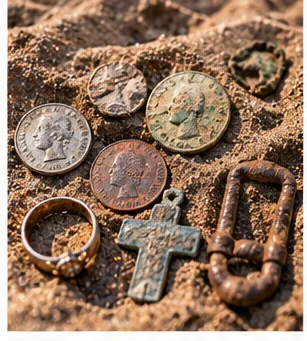
Whether a find is yours to keep depends first on the land, then on what the object is. Federal and tribal land is tightly restricted, state and local rules vary, and private land is governed by your agreement with the owner. Stop for human remains, hazards and anything that may be protected, and ask the managing agency. This is not legal advice.
In This Guide
Affiliate disclosure: We may earn a commission from qualifying purchases made through links on this page, at no extra cost to you.
Whose find is it? Start with the land
A find is not just an object. It comes with a place, and the place often decides who has a say. The same coin, button or point can be yours to keep on one site, a matter for the landowner on another and protected from removal on a third. Three questions sort most cases: who owns or manages the land, what kind of object is it and does a rule require you to stop or report?
The rules differ by country, state, province, county and agency, and they change. This guide is a general framework to help you ask the right person the right question. It is not legal advice, and it does not replace advice from the land manager, a state agency or a lawyer. Our laws and permissions overview and the laws and etiquette guide go through the wider picture.
Federal and tribal land
This is where the rules are tightest. In the United States, the National Park Service regulation on resource protection says that possessing or using a mineral or metal detector in a park area is prohibited, with exceptions that include a detector that is broken down and stored so it cannot be used, and detectors used for authorized scientific, mining or administrative activities. The same regulation prohibits possessing, destroying, injuring, defacing, removing, digging or disturbing cultural or archeological resources (36 CFR 2.1, as read in October 2026).
The Archaeological Resources Protection Act, or ARPA, covers archaeological resources on public lands and Indian lands. The National Park Service describes a permit system for archaeological investigations, criminal penalties that include prison time, and the confiscation of equipment used in an offense, such as metal detectors and vehicles. The definition of an archaeological resource includes an age threshold, and the agency that manages the land can explain how it applies to a particular object.
Tribal and Native American lands are a separate category, with their own authorities and rules. If you are unsure whose land you are on, stop and find out before you swing a coil.
State, county and city land
State parks, wildlife areas, county parks and school grounds each have their own policy, and many of them restrict or prohibit metal detecting or digging. Some states have laws about historic or archaeological objects on state land, and some have offices that handle them. Where your state has a state archaeologist or a state historic preservation office, those are good places to ask when you find something old. The managing agency, parks office or school district can tell you the rule for the site.
Do not assume that a lack of signs means permission. Ask, and if you can get the answer in writing, even an email, keep it with your hunting notes.
Private land: put the agreement in writing
On private land, the owner's permission is the starting point, and the agreement between you and the owner usually covers what happens to finds. A short written note avoids misunderstandings later. It should cover who keeps what, what happens to anything unusual, where you may walk and dig, and when you will come. Our guide to getting permission on private property includes a way to ask.
Even on private land, some finds are not a simple matter of owner and finder. Human remains, for example, call for an immediate stop and a call to the local authorities. For valuable personal items such as rings, our gold ring guide covers the practical steps. Some jurisdictions also have rules for burial sites, historic cemeteries or shipwrecks that apply regardless of who owns the land. When in doubt, stop and ask.
When a find calls for a stop
| What you may have found | First move | Who to ask |
|---|---|---|
| Possible human remains or burial items | Stop digging and leave things where they are | Local law enforcement; the land owner or manager |
| Native American or tribal cultural items | Stop, do not remove or clean anything | The land manager and, where relevant, tribal authorities or the state agency for historic preservation |
| Old artifact on public land | Leave it in place if it is protected; record the location | The managing agency; the state archaeologist or state historic preservation office |
| Possible ordnance, weapons or anything hazardous | Do not touch, move or dig further; keep others away | Local police or emergency services |
| Jewelry, ID, a wallet or other lost personal property | Photograph it and note where you found it | The land owner or manager, or local police; check local lost property rules |
| Something in or near water that looks like a wreck | Stop and record the location | The managing agency or state office that handles submerged resources, which varies by state |
The table is a guide to the first move, not a ruling on ownership. Your local agency can tell you what applies where you are.
Record it, do not rush it
A good record protects you and helps whoever reviews the find. Photograph the object in place, with something for scale if you carry it, and a wider shot showing the surroundings. Note the date, the place (a pin on a map app works), the depth if you can judge it and what was around. Then fill the hole or protect the spot as the managing agency or owner directs. Do not clean or alter an object that may be historically important, because cleaning can remove evidence. Our cleaning and preserving finds guide is for finds that are yours to keep.
Waterproof field notebook
A small notebook that takes pencil in wet weather is a simple way to log finds and permissions. Choose one that fits a pocket.
Photo scale ruler
A small folding ruler or scale card gives a photo a measure of size. Check that it is easy to read in a photo.
Keep your permission notes, site rules and records in one place. If a question comes up later, a tidy file is far more useful than a memory.
Bottom line
Who owns or manages the land comes first, then what the object is. Federal and tribal land is tightly restricted, state and local rules vary, and private land is governed by your agreement with the owner. Stop for human remains, ordnance and anything that may be protected, record where you are, and ask the managing agency. This is general information, not legal advice.
Frequently Asked Questions
Can I keep what I find with a metal detector?
It depends on the land and the object. Rules differ by country, state, province and agency. Ask the land owner or manager, and do not treat this guide as legal advice.
What should I do if I find human remains?
Stop digging, leave things where they are and contact local law enforcement. This applies on public and private land.
Is metal detecting allowed in national parks?
Under the National Park Service regulation we read, possessing or using a metal detector in a park area is prohibited, with listed exceptions such as a detector stored so it cannot be used. Confirm with the park.
What is ARPA?
The Archaeological Resources Protection Act covers archaeological resources on public lands and Indian lands. The National Park Service describes a permit system, criminal penalties and confiscation of equipment.
Who do I ask about an old artifact I found?
Start with the land owner or the managing agency. Where your state has a state archaeologist or a state historic preservation office, they are good contacts for old finds.
Sources and verification
Federal points in this guide come from these pages, read in October 2026:
- 36 CFR 2.1, Preservation of natural, cultural and archeological resources (eCFR): prohibition on possessing or using a metal detector in park areas and its listed exceptions, and the prohibition on disturbing cultural or archeological resources.
- National Park Service, Archaeological Resources Protection Act: coverage of public and Indian lands, permits for archaeological investigations, criminal penalties and confiscation of equipment.
We did not confirm the age threshold in the ARPA definition on a page we could open, so this guide does not state it. State, county, tribal and international rules were not reviewed; ask the managing agency, your state archaeologist or historic preservation office, and a lawyer if the stakes are high.
DetectorGear.co is a participant in the Amazon Services LLC Associates Program and the eBay Partner Network. When you purchase through links on this page, we may earn a commission at no additional cost to you. Affiliate relationships do not influence our editorial recommendations. Learn more.